
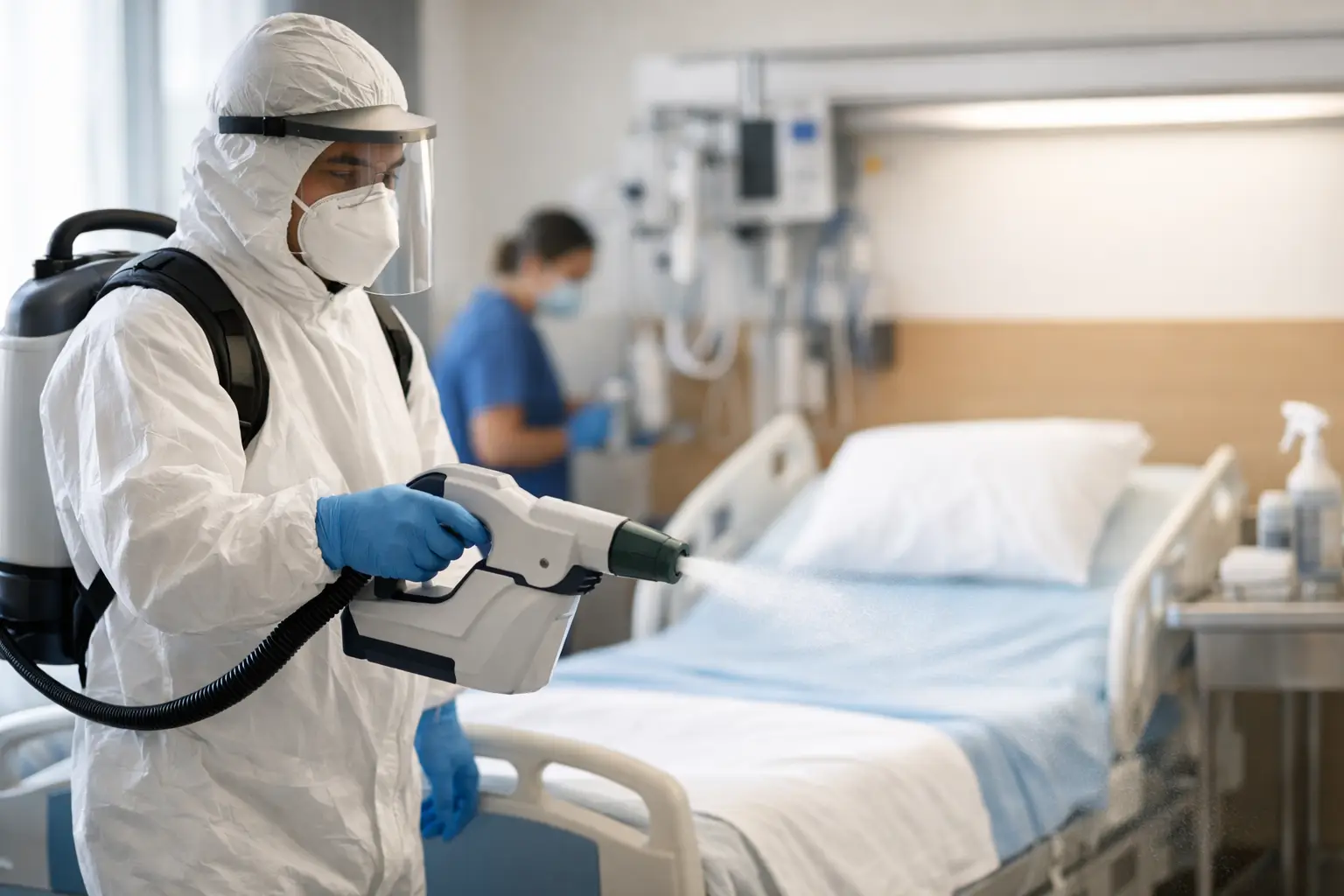
A hospital disinfection example is not a cleaner arriving with a disinfectant bottle and treating every surface the same way. It is a controlled process that matches cleaning methods, products, contact times and staff protection to the risk within each clinical area. For facility managers, the outcome is clear: a safer environment for patients, visitors and healthcare workers, supported by records that demonstrate the work has been completed properly.
In a hospital, a missed touchpoint can have greater consequences than a poorly presented foyer. High patient turnover, vulnerable occupants, bodily fluid incidents and around-the-clock activity all affect how a cleaning program must be planned. Effective disinfection starts with site intelligence, not a generic checklist.
Hospital Disinfection Example: A Patient Room Turnover
Consider a single patient room being prepared after discharge and before its next occupant arrives. The room includes a bed frame, mattress, bedside table, call bell, television remote, light switches, door handles, bathroom fixtures and clinical waste areas. These are high-touch surfaces, but they do not all present the same cleaning challenge.
Before work begins, the cleaning team confirms whether the room has standard turnover requirements or additional precautions advised by the hospital’s infection prevention and control team. A room used by a patient with a known or suspected infectious condition may require an enhanced process, specific personal protective equipment and a defined release procedure before it can return to service.
The cleaner first removes waste and used consumables in line with the site’s waste segregation procedures. Linen is handled carefully to avoid dispersing contaminants. Visible soil and spills are dealt with before disinfection, because disinfectant is less effective when dirt, organic material or residue remains on a surface.
Using colour-coded equipment allocated to the clinical zone, the cleaner then works from cleaner areas towards dirtier areas and from high surfaces to low surfaces. The bed frame, bedside table, call bell, switches, handles and bathroom touchpoints are cleaned with an approved product and method. Fresh cloths or wipes are changed as required so contamination is not transferred from one surface to another.
Disinfectant is applied according to the product label and the hospital’s approved procedure. This matters because the surface must remain wet for the stated contact time. Wiping a product away immediately may leave a surface looking clean without delivering the required disinfection result. The room is then inspected, restocked where required and documented as ready for the next patient.
That is the practical difference between appearance cleaning and clinical disinfection. The room must look orderly, but the essential measure is whether the cleaning process has reduced contamination at the points people touch most often.
Why Risk Assessment Comes Before Product Selection
There is no single disinfectant, dilution or frequency that suits every hospital space. Emergency departments, operating theatres, waiting rooms, staff amenities, isolation rooms and administration areas each have different traffic patterns and exposure risks.
A risk assessment should consider the type of activity carried out in the area, patient vulnerability, frequency of touch, likelihood of contamination, surface materials and the time available between use. For example, a public waiting room may need regular attention to armrests, reception counters, EFTPOS terminals, doors and bathroom facilities throughout the day. An operating theatre requires a more tightly controlled between-case and terminal cleaning process under the site’s clinical governance requirements.
Product selection also depends on compatibility. Stronger is not always better. Some disinfectants can damage screens, upholstery, flooring, medical equipment or protective coatings if used incorrectly. Facility managers need approved products that are suitable for their intended purpose, used at the correct dilution where applicable, and applied in accordance with manufacturer directions and site protocols.
The Critical Controls Behind Reliable Results
A hospital disinfection program succeeds when its controls are repeatable across shifts, teams and sites. Individual effort is valuable, but systems protect standards when workloads change or urgent incidents occur.
Cleaning comes before disinfection
A disinfectant cannot reliably penetrate heavy soil, blood or other organic matter. Staff must first remove contamination using the correct cleaning method, then disinfect the surface where required. This sequence is especially relevant in bathrooms, clinical treatment spaces and after spills.
Contact time cannot be guessed
Every approved disinfectant has instructions for use, including the required contact time. Supervisors should ensure staff understand that a surface needs to stay wet for that period. Spraying a surface from a distance and immediately wiping it dry is not a dependable method.
Equipment must stay within its zone
Mops, cloths, buckets and other equipment can spread contaminants when they move between bathrooms, patient zones and public areas without control. Colour coding, dedicated equipment, laundering procedures and replacement schedules help prevent cross-contamination. Single-use materials may be appropriate for particular tasks or precaution areas.
Staff protection is part of the process
Personal protective equipment must match the task and the exposure risk. Gloves are not a substitute for hand hygiene, and wearing the same gloves from one task to the next can transfer contamination. Teams need clear procedures for putting on, removing and disposing of PPE safely.
Frequency Should Follow Activity, Not Just the Clock
A fixed daily schedule can be useful, but hospital cleaning must respond to actual use. A reception desk after a busy outpatient clinic, a bathroom near an emergency waiting area and a treatment bay following a patient transfer may all need additional attention before the next scheduled round.
High-touch surfaces generally require more frequent cleaning and disinfection than low-touch surfaces. These can include bed rails, call bells, taps, flush buttons, handrails, lift buttons, door plates, keyboards, phones and shared clinical equipment. The exact scope should be defined by the hospital’s policies, risk profile and infection prevention advice.
Responsive cleaning is also essential after spills. Staff should know who to contact, how to isolate the area if necessary, what spill kit or approved materials to use, and when the incident must be escalated. Delays or improvised methods create avoidable risk.
Documentation Turns Activity Into Accountability
For a healthcare facility, a completed task is not enough if there is no way to verify what happened, when it occurred and whether exceptions were managed. Documentation provides operational visibility for cleaning supervisors, facility managers and clinical teams.
A useful program records scheduled tasks, completed rounds, room turnovers, spill responses, product batches where required, staff training, equipment checks and corrective actions. Digital reporting can make this information easier to review across multiple wards or sites, particularly for organisations operating extended hours.
Quality assurance should include regular inspections rather than relying solely on sign-off sheets. Visual checks identify presentation issues, while targeted auditing can test whether high-touch surfaces are being cleaned to the expected standard. Where a gap is found, the response should be practical: retrain the team, adjust the workflow, review staffing levels or improve access to supplies.
Where Outsourced Teams Add Value
Healthcare cleaning requires more than labour coverage. An external provider needs trained personnel, site-specific induction, reliable supervision, clear escalation pathways and the ability to work around clinical operations without disrupting care.
For multi-site operators, consistency is often the deciding factor. A provider that can coordinate cleaning, waste management, carpet care, window cleaning and general property maintenance may reduce vendor complexity while keeping one accountable service framework. However, consolidated service only works when specialist infection control requirements remain clearly defined and clinically aligned.
Perfect One Services supports healthcare and commercial facilities with customised cleaning programs, responsive service coverage and disciplined hygiene procedures. The right plan should be based on your site’s risk profile, operating hours, patient flow and existing infection control governance.
The most useful hospital disinfection example is one that can be repeated at 2 am as reliably as it can at 10 am: the right surface, the right method, the right contact time and clear evidence that the room is safe to return to use.