
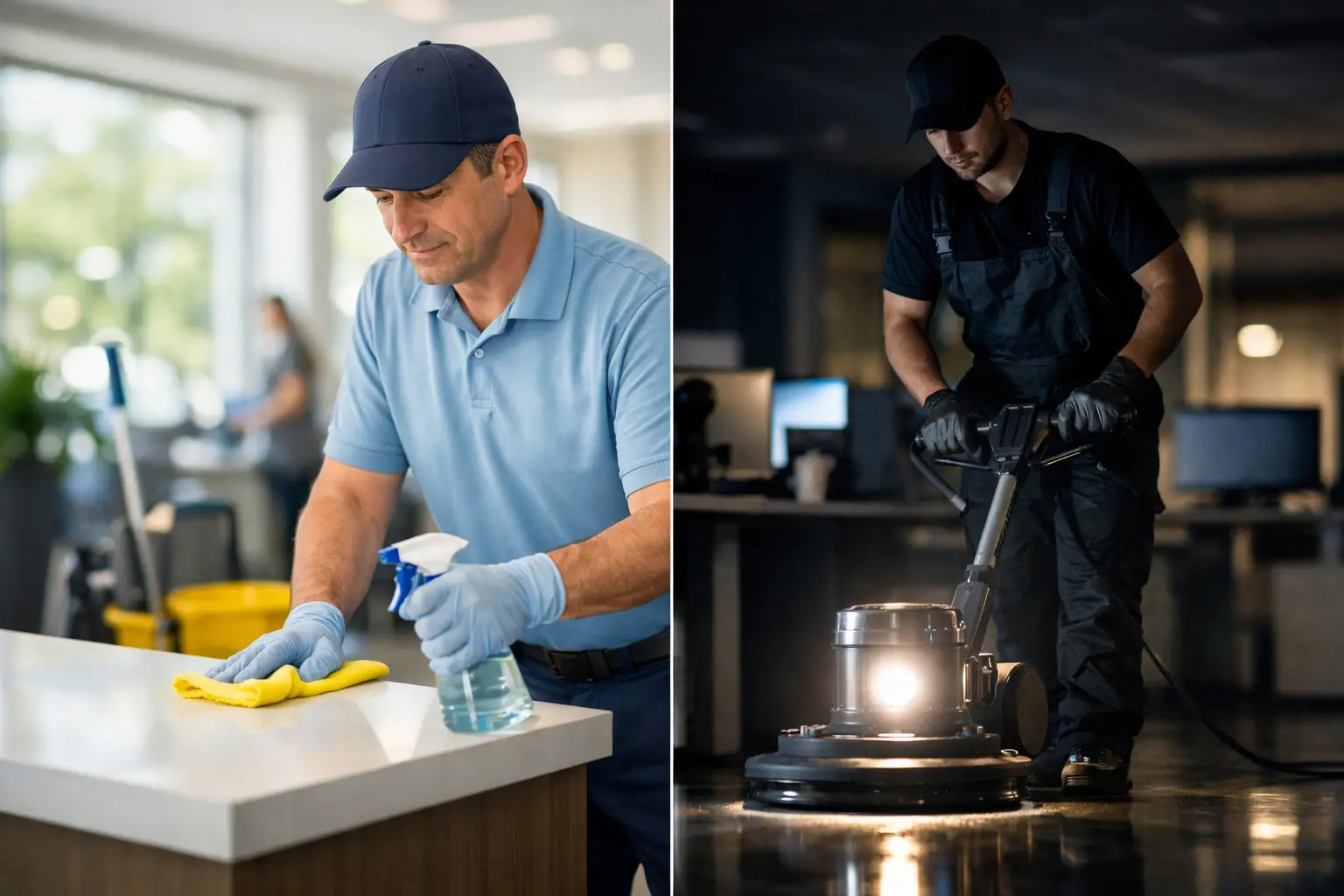
A foyer can look spotless at 8:00 am and tired by 11:30. Washrooms run low on supplies, fingerprints build up on glass, bins overflow, and high-traffic entries start to affect the way a site feels to staff, visitors and tenants. That is where the real difference in day porter vs night cleaning becomes clear. One model keeps your site presentable and responsive during operating hours. The other restores it after hours with fewer interruptions.
For facility managers, property managers and operations teams, this is not just a cleaning question. It affects presentation, hygiene, labour efficiency, tenant satisfaction and how smoothly the day runs. The right choice depends on how your building is used, how visible cleanliness needs to be, and whether issues need to be handled as they happen or after the site is empty.
Day porter vs night cleaning: the core difference
A day porter works while your site is active. Their role is not limited to a single clean at a set time. They manage ongoing presentation and hygiene throughout the day, usually in shared spaces and high-traffic areas. That can include spot cleaning, washroom checks, consumable restocking, bin management, touchpoint sanitising, lobby presentation and responding to incidental mess.
Night cleaning happens after hours, when staff, customers, students or tenants have largely left the premises. It is typically more comprehensive and task-based. Vacuuming, mopping, amenities cleaning, rubbish removal, detailed kitchen cleaning and full-area resets are often completed in this window because access is easier and disruption is lower.
Neither option is automatically better. They solve different operational problems.
What a day porter is really there to do
A day porter supports live site conditions. In busy commercial and public-facing environments, cleanliness does not hold from morning to evening without active attention. A porter helps maintain standards in real time rather than waiting for problems to accumulate.
In an office tower, that might mean keeping reception and lift lobbies presentable, checking washrooms before peak periods and addressing spills before they become safety risks. In a shopping environment, it could involve managing food court cleanliness, monitoring bins and keeping glazing, entrances and common areas in order. In strata and mixed-use properties, the role often supports resident and visitor experience by maintaining shared spaces throughout the day.
This model is especially valuable where presentation is constant and visible. A day porter can also act as an extra set of operational eyes, flagging maintenance issues such as leaking taps, damaged fixtures or consumable shortages before they become larger service problems.
What night cleaning does best
Night cleaning is usually the foundation of a commercial cleaning program. It allows cleaners to access larger areas without foot traffic, work more efficiently around desks and shared spaces, and complete deeper routine tasks that are harder to perform while a site is operating.
For many office, education and industrial settings, night cleaning is the practical choice because it removes disruption. Floors can be cleaned without people moving through them. Amenities can be serviced thoroughly. Rubbish can be removed in bulk. Kitchens, meeting rooms and work areas can be reset for the next day.
It is often more cost-effective for sites that do not need visible daytime support. If your workplace has moderate traffic, limited public access and relatively stable usage patterns, an after-hours clean may cover your needs well.
Day porter vs night cleaning for different site types
The best model depends heavily on the environment.
In premium offices, day porter services are often used to support front-of-house presentation and washroom upkeep, while night cleaning handles the full evening clean. Office staff and visitors notice dirty amenities and untidy common areas quickly, so daytime support can protect workplace experience.
In retail settings, day porter coverage is often harder to avoid. Customer-facing spaces need continuous attention, especially at entries, food-adjacent areas, lifts, escalators and amenities. Waiting until night can mean letting standards slip during trading hours.
In healthcare, childcare and education sites, the decision is even more sensitive. Infection control, touchpoint hygiene and rapid response to spills or bodily fluid incidents may require daytime attendance, while night cleaning completes broader sanitation and reset tasks. Compliance and risk management often drive a blended approach.
In industrial sites, the answer varies. Some operations can be serviced effectively after hours. Others need day support in lunchrooms, amenities, administration areas and shared access points because usage is heavy and continuous.
For strata properties, it often comes down to occupancy patterns and resident expectations. High-rise buildings with frequent visitor traffic, active common areas and premium presentation standards often benefit from a porter presence during the day.
The trade-offs decision-makers should weigh
Day porter services improve responsiveness, but they are not a substitute for a structured night clean. A porter keeps conditions under control. They do not usually replace the larger, methodical tasks completed after hours.
Night cleaning is efficient for full-site execution, but it does not solve presentation problems that arise at 10:00 am or hygiene issues that peak after lunch. If your washrooms are heavily used or your entrance areas deteriorate quickly, relying on a single evening clean can create a visible gap.
Cost is part of the equation, but it should be considered against risk and expectations. A lower-cost night-only model may look economical on paper, but if complaints increase, presentation suffers or hazards go unattended during the day, the real operational cost can be higher.
There is also the question of access and security. Some businesses prefer after-hours cleaning to minimise interaction with staff and protect workflow. Others want a daytime presence because issues need immediate attention and a visible cleaner reassures occupants that standards are actively managed.
When a combined model makes the most sense
For many commercial sites, the most effective answer is not choosing one over the other. It is combining both.
A blended model uses night cleaning for full scheduled cleaning and a day porter for maintenance, touchpoint hygiene and response-based tasks. This is often the strongest option for large offices, retail centres, medical facilities, schools, strata complexes and multi-tenant sites where cleanliness affects both compliance and experience.
The benefit is continuity. Your premises are properly cleaned and reset after hours, then maintained throughout the day as occupancy creates new demands. That helps protect asset presentation, reduce complaints and support safer, more orderly operations.
It also improves service flexibility. If your building has changing traffic patterns, seasonal surges, events, inspections or infection control pressures, a combined model is easier to adjust than a single fixed cleaning window.
Questions to ask before choosing
Before deciding on day porter vs night cleaning, look closely at how the site behaves rather than how the contract has always been structured.
Ask when cleanliness issues become visible. If complaints usually happen in the middle of the day, night cleaning alone may be missing the mark. Consider whether washrooms, entrances, lifts, kitchens or shared areas need active management while people are on site.
Review occupancy patterns and service expectations. A corporate head office, a childcare centre and a warehouse office may all need different cleaning rhythms even if they occupy similar floor area. Also consider whether your cleaning provider can coordinate broader facility support. In many environments, cleaning, waste management, consumables, minor maintenance and presentation all overlap.
The strongest cleaning model supports the building as it is actually used, not just the roster that is easiest to schedule.
Choosing a service model that supports operations
Cleaning should do more than remove dirt. It should support how people move through a property, how tenants or visitors judge it, and how safely the environment performs across the day. That is why day porter vs night cleaning is really a facilities decision.
A well-run site may need a silent after-hours team, an active daytime presence, or both. The right solution comes from matching service hours to traffic, hygiene risk, presentation standards and operational pressure points. For organisations managing multiple sites or mixed-use environments, that often means a tailored service plan rather than a standard package.
At Perfect One Services Australia, this is the practical approach: align cleaning coverage with the way the site operates, then build in the support needed to keep standards consistent. If your premises look fine at opening but struggle by midday, that is usually your answer. Cleanliness should hold up when your building is busiest, not just when nobody is there.