
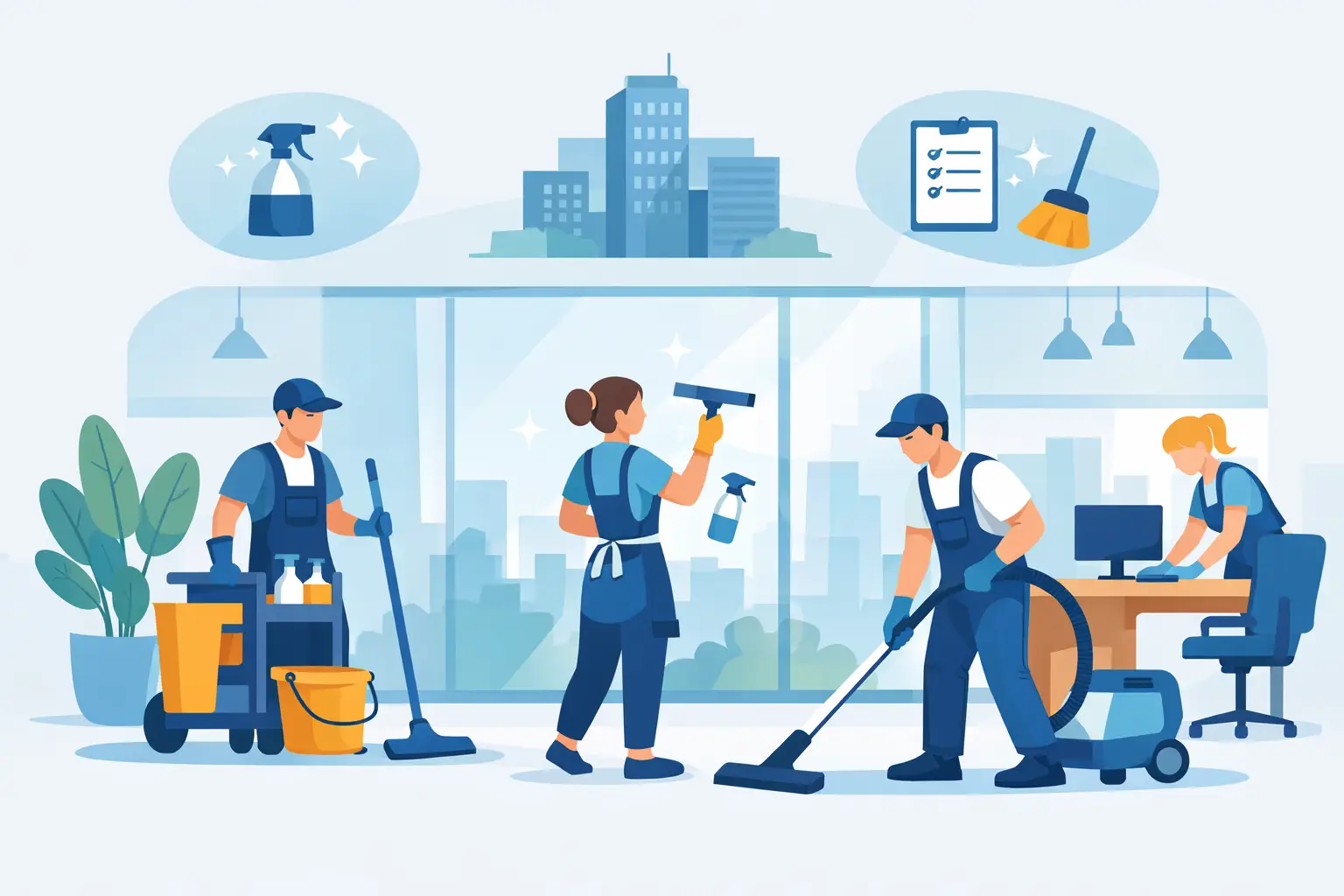
If you manage an office, school, medical site, strata complex or retail premises, a cleaner turning up with a mop is only a small part of the picture. When people ask what are commercial cleaning services, they are usually trying to understand something bigger – how businesses keep sites clean, compliant, presentable and safe without leaving standards to chance.
Commercial cleaning services are professional cleaning solutions delivered to business, institutional and shared-use environments. Unlike domestic cleaning, they are built around operational schedules, risk controls, site-specific requirements and measurable service outcomes. That means the scope can range from daily office cleaning and washroom hygiene through to infection control, floor care, waste handling, window cleaning and support for high-traffic or regulated environments.
For facility managers and procurement teams, the distinction matters. Commercial cleaning is not simply about appearance. It supports workplace health, helps maintain compliance, protects assets and reduces disruption across the day-to-day running of a site.
What are commercial cleaning services in practical terms?
In practical terms, commercial cleaning services are structured cleaning programs designed for workplaces and public-facing properties. They are delivered by trained teams using commercial-grade equipment, documented procedures and schedules that fit the site.
A standard office may need after-hours cleaning of workstations, kitchens, meeting rooms, amenities and shared touchpoints. A childcare centre may need stricter hygiene routines, sanitising protocols and careful product selection. A medical facility requires a higher level of infection prevention, waste segregation and attention to clinical-risk areas. An industrial site may need sweeping, scrubbing and heavy-duty cleaning that can handle grease, dust and operational residue.
The service is shaped by the environment, the traffic volume, the compliance pressure and the consequences of poor hygiene. That is why commercial cleaning is usually planned as a recurring service rather than a one-off tidy-up.
What commercial cleaning services usually include
The scope depends on the property, but most commercial cleaning programs cover core routine tasks and periodic specialist work. Routine services often include vacuuming, mopping, dusting, emptying bins, cleaning bathrooms, restocking consumables, wiping high-touch surfaces and maintaining kitchens or staff break areas.
Beyond that, many businesses need more specialised support. This can include carpet cleaning, internal and external window cleaning, hard floor stripping and sealing, high-pressure cleaning, deep sanitation, sweeping and scrubbing, and waste management or recycling support.
For many organisations, the real value comes when cleaning is integrated with broader facility services. Instead of coordinating separate contractors for maintenance, plumbing, electrical issues, handyman works and presentation-related tasks, they can work with one operational partner. That approach reduces vendor complexity and can make accountability much clearer.
Where commercial cleaning services are used
Commercial cleaning applies to far more than office towers. It is used anywhere people work, visit, learn, shop, exercise or receive care.
Office environments need consistent presentation and hygiene to support staff wellbeing and create the right impression for clients. Retail spaces need visible cleanliness during trading and often require flexible scheduling around customers. Strata properties rely on common-area cleaning to maintain resident satisfaction and protect property value. Schools and childcare centres need reliable hygiene practices in high-contact settings. Gyms need constant attention to amenities, touchpoints and odour control. Healthcare environments need disciplined cleaning systems that align with infection control requirements.
Industrial and warehouse facilities have another layer again. Dust, debris, loading traffic and operational waste can quickly affect safety and presentation if cleaning is not handled with the right equipment and frequency.
Why businesses invest in commercial cleaning
The obvious reason is cleanliness, but business decisions are rarely made on appearance alone. Commercial cleaning supports several operational priorities at once.
First, it improves hygiene and helps reduce the spread of germs in shared environments. That matters in every workplace, but especially in schools, childcare, healthcare and high-density office settings.
Second, it supports compliance. Many industries have obligations around sanitation, safety, waste handling and infection control. A professional commercial cleaning provider should understand how those obligations affect cleaning methods, frequencies and record-keeping.
Third, it protects the condition of the premises. Carpets, hard floors, fixtures, glass and amenities last longer when they are maintained correctly. Deferred cleaning often becomes expensive restoration.
Fourth, it helps operations run smoothly. Clean amenities, stocked consumables, clear common areas and well-maintained presentation standards reduce friction for staff, tenants, visitors and customers.
Finally, it can simplify contractor management. When cleaning sits inside a broader facilities model, businesses often gain better coordination across hygiene, maintenance and site presentation.
The difference between domestic and commercial cleaning
This is where some confusion starts. Domestic cleaning is usually designed around household preferences and lighter-use environments. Commercial cleaning is designed around business continuity, higher traffic, formal scopes and service accountability.
A commercial contract may specify cleaning frequencies, site access rules, security procedures, safe work methods, escalation processes and performance standards. Teams may need inductions, police checks, infection control training or experience working around sensitive operations. The equipment is different, the scheduling is different and the consequences of inconsistent delivery are usually much higher.
That is also why price comparisons between domestic-style cleaning and commercial cleaning can be misleading. A lower quote may not include the supervision, documentation, training, insurance profile or specialist capability needed for a commercial site.
What to expect from a professional commercial cleaning provider
A capable provider should start with the site, not a generic package. Every property has its own traffic patterns, risk points, presentation standards and access constraints. A tailored plan is usually a sign that the provider understands operational reality.
You should expect a clear scope of works, agreed service frequencies, defined responsibilities and a process for quality control. In more complex environments, that may also include hygiene protocols, infection control measures, safety documentation and reporting.
Reliability matters just as much as technical cleaning ability. If a provider cannot respond when access changes, an incident occurs or an urgent clean is required, the contract can become a management burden rather than a solution.
This is where national coverage and 24/7 capability can make a practical difference for multi-site businesses. A provider such as Perfect One Services Australia positions itself around that operating model – consistent service delivery across major cities, supported by tailored plans and broader facility support where clients need more than standard cleaning alone.
How service frequency and scope are decided
There is no universal cleaning schedule that suits every property. It depends on occupancy, industry, trading hours, public access, compliance obligations and budget.
A corporate office may only need a deeper periodic clean on top of regular nightly service. A gym may need repeated amenity checks across the day. A medical centre may need ongoing disinfecting of touchpoints and stricter waste practices. A strata building may need a combination of daily common-area attention and scheduled pressure cleaning or window work.
The trade-off is straightforward. If the scope is too light, standards slip and issues build up. If the scope is too heavy, you may be paying for service levels the site does not need. The right provider should help you find the point where hygiene, presentation and cost are properly balanced.
Signs your business needs a better commercial cleaning arrangement
Sometimes the need is obvious – complaints, odours, dirty amenities or presentation issues that clients notice straight away. Other times it shows up more quietly through inconsistent service, missed tasks, unclear communication or too many contractors handling related site issues separately.
If your team is chasing cleaners for updates, restocking problems keep recurring, or specialist needs such as carpets, windows or washroom hygiene are being arranged ad hoc, the arrangement may be underpowered. The same applies if your site has changed use, headcount or compliance requirements but the cleaning plan has not changed with it.
A good commercial cleaning program should feel controlled, not improvised.
Choosing the right commercial cleaning partner
The right partner is not always the cheapest, and not always the largest. What matters is fit. You need a provider with the right sector experience, dependable supervision, responsive communication and enough capability to scale with your site or portfolio.
For regulated or high-traffic settings, ask how they manage safety, infection control, staff training and quality assurance. For multi-site operations, ask how they maintain consistency across locations. For property and facilities teams, it is also worth looking at whether the provider can support related services beyond cleaning, because every extra contractor adds admin, risk and coordination time.
When people ask what is commercial cleaning services, the best answer is this: it is a business-critical support function that keeps workplaces hygienic, presentable and operational. Done properly, it protects more than appearance. It supports people, compliance and the standard your organisation is expected to maintain every day.